
What is Pudendal Neuralgia?
Pudendal neuralgia is a condition in which irritation or damage to the pudendal nerve causes pelvic pain and/or dysfunction. Common symptoms of pudendal neuralgia include:
- Pain, numbness, tingling in the clitoris, labia, vagina (female), scrotum (male), perineum, or rectum
- Pain or difficulty with urination, or sexual intercourse
- Increased urinary urgency and/or frequency
- Pain typically worsens with sitting
Anatomy
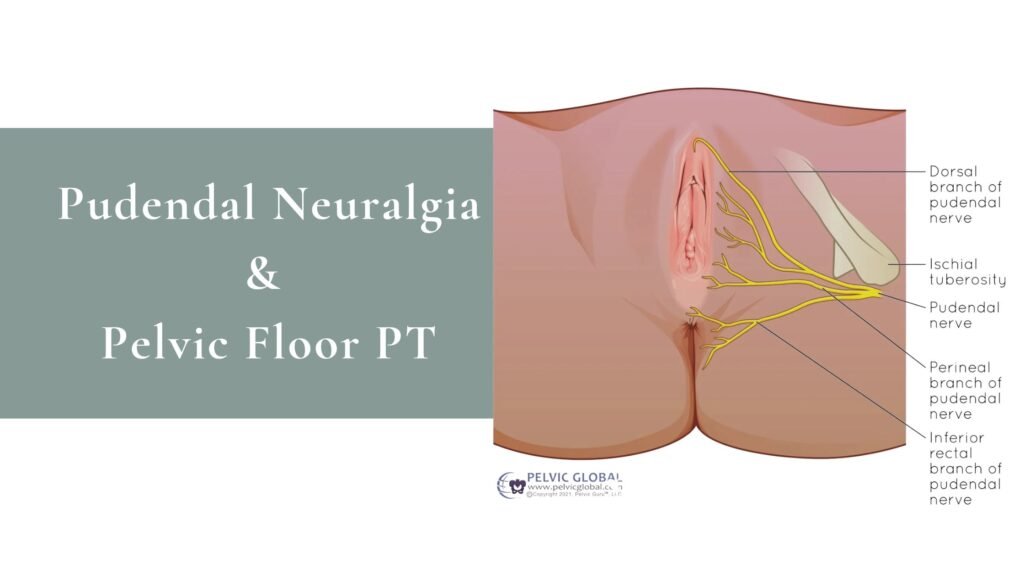
The pudendal nerve originates from the S2-S4 sacral nerve roots. It then exits the pelvis through the greater sciatic foramen, and reenters the pelvis at the lesser sciatic foramen. Upon reentering the pelvis, it travels through the pudendal canal (also known as Allock’s canal). This pathway involves several close-to-90 degree turns, which puts this nerve at a higher risk of getting irritated through compression or overstretching. The three most common sites of irritation include the sacrospinous ligament, the sacrotuberous ligament, and Allock’s canal.
The pudendal nerve has motor, sensory, and autonomic functions:
- Motor: controls function of the levator ani muscle group, external anal sphincter, and external urethral sphincter
- Sensory: supplies sensation to the clitoris, the back portion of the labia majora, labia minora, and vaginal vestibule, and the skin around the anus
- Autonomic: helps modulate sexual arousal
Causes
Nerves like blood flow, and when blood flow is restricted to the nerve we start to see symptoms. As mentioned above, prolonged compression and/or overstretching are common ways to restrict blood flow to a nerve.
The following are several of the most common causes of pudendal neuralgia specifically:
- Sitting sports (cycling, horseback riding)
- Sports that involve prolonged sitting, such as cycling and horseback riding can result in compression of the pudendal nerve for extended periods of time.
- Prolonged sitting
- Similar as above, prolonged sitting in general can also result in compression and irritation of the pudendal nerve.
- Muscle tension
- Increased tension of the pelvic floor muscles and/or obturator internus can compress the pudendal nerve
- Trauma (birth, falls, surgical complications)
- In the case of trauma, the nerve may become physically damaged or severed.
- Axonotmesis – the nerve is damaged, but can heal (slowly, at approx 1mm/day)
- Neurotmesis – the nerve is severed and spontaneous recovery is unlikely
- In the case of trauma, the nerve may become physically damaged or severed.
Treatment
There are a variety of treatment options for pudendal neuralgia. Doctors will often start by prescribing the more conservative methods (pelvic floor physical therapy or medication) prior to recommending ablation or surgery.
- Physical therapy
- The goal of pelvic floor physical therapy for pudendal neuralgia is to reduce/eliminate the compression or stretch on the pudendal nerve. After an in-person evaluation, a therapist will create a customized program of exercises, stretches, and activities that may include:
- activity modification
- nerve glides
- stretches
- strength/stability exercises
- coordination exercises
- manual work to reduce muscle tension
- dry needling to help calm the surrounding musculature
- The goal of pelvic floor physical therapy for pudendal neuralgia is to reduce/eliminate the compression or stretch on the pudendal nerve. After an in-person evaluation, a therapist will create a customized program of exercises, stretches, and activities that may include:
- Medication
- Different types of medications may be prescribed to target various symptoms associated with pudendal neuralgia. These may include:
- Muscle relaxers
- Analgesics (painkillers)
- Anticonvulsants (to calm overactive nerves)
- Different types of medications may be prescribed to target various symptoms associated with pudendal neuralgia. These may include:
- Nerve blocks
- These are typically injections that combine a local anesthetic with a steroid, to calm down the nerve irritation
- Ablation
- Minimally invasive procedure to freeze, burn, or destroy the nerve fibers (depending on the type of ablation)
- Surgical decompression
- Surgical release of the pudendal nerve. There are a variety of techniques. Which one is chosen is dependent on the case and the surgeon.