

Want this Return-to-Running guide as an easy checklist?
Download the Return-to-Run Checklist FREE, direct PDF link here:
The Primary Care Physician’s Guide to Return-to-Run Protocol, Pelvic Floor Dysfunction Screening, & Referral
Pelvic floor dysfunction is common, underreported, and frequently missed in primary care settings. Many patients normalize symptoms such as urinary leakage, pelvic pressure, painful intercourse, constipation, or persistent postpartum weakness and assume these are simply part of aging, childbirth, or exercise. In reality, these symptoms are treatable, and early identification can significantly improve quality of life.
Primary care physicians are uniquely positioned to identify pelvic floor concerns early, initiate appropriate referrals, and support postpartum patients in safely returning to exercise.
Pelvic Floor Dysfunction Screening:
Symptoms may present subtly and often overlap, mimic, or cause orthopedic, gastrointestinal, or urologic complaints. Patients are unlikely to self-report symptoms (even when bothersome) so it is important to ask by screening them.
A simple validated tool such as the Cozean Pelvic Dysfunction Screening Protocol can help identify patients who may benefit from pelvic floor physical therapy. If a patient checks 3 or more of the following items, pelvic floor dysfunction is likely, and warrants referral to a pelvic floor PT:
- I sometimes have pelvic pain (in genitals, perineum, pubic or bladder area, or pain with urination) that exceeds a ‘3’ on a 1-10 pain scale, with 10 being the worst pain imaginable.
- I can remember falling onto my tailbone, lower back, or buttocks (even in childhood)
- I sometimes experience one or more of the following urinary symptoms
- Accidental loss of urine
- Feeling unable to completely empty my bladder
- Having to void within a few minutes of a previous void
- Pain or burning with urination
- Difficulty starting or frequent stopping/starting of urine stream
- I often or occasionally have to get up to urinate two or more times at night
- I sometimes have a feeling of increased pelvic pressure or the sensation of my pelvic organs slipping down or falling out
- I have a history of pain in my low back, hip, groin, or tailbone or have had sciatica
- I sometimes experience one or more of the following bowel symptoms
- Loss of bowel control
- Feeling unable to completely empty my bowels
- Straining or pain with a bowel movement
- Difficulty initiating a bowel movement
- I sometimes experience pain or discomfort with sexual activity or intercourse
- Sexual activity increases one or more of my other symptoms
- Prolonged sitting increases my symptoms
Cozean Pelvic Dysfunction Protocol Screening pdf link
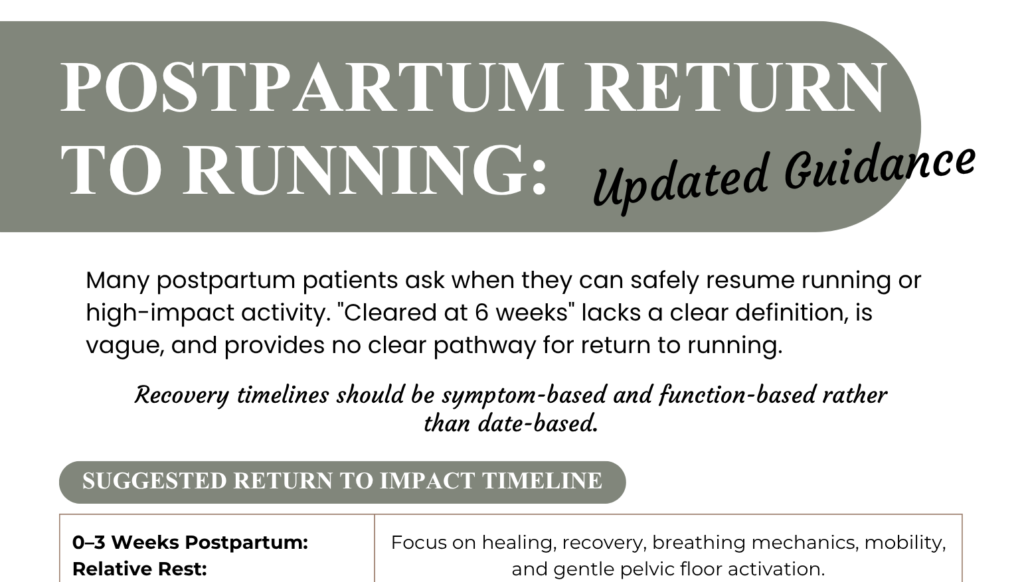
Postpartum Return to Running: Updated Guidance
Many postpartum patients ask when they can safely resume running or high-impact activity. “Cleared at 6 weeks” lacks a clear definition, is vague, and provides no clear pathway for return to running.
Recovery timelines should be symptom-based and function-based rather than date-based.
Suggested Return to Impact Timeline (1)
- 0–3 Weeks Postpartum: Relative Rest: Focus on healing, recovery, breathing mechanics, mobility, and gentle pelvic floor activation.
- 3–12 Weeks Postpartum: Low-Impact Activity: Walking, low-impact exercise, gradual loading, and beginning strength work as tolerated.
- Before Running: Complete a Run-Readiness Screening Running should begin only after key physical and pelvic health benchmarks are met.
- Walk to Run Protocol Once Cleared (2) Median return-to-run time in current literature is approximately 12 weeks postpartum.
Run-Readiness Screening for Postpartum Patients (3)
Domain 1: Medical & Psychological Readiness
- Wound healing complete
- No vaginal bleeding unrelated to menses
- No severe abdominal pain or signs of infection
- Screened for postpartum depression/anxiety
Domain 2: Pelvic Floor Symptoms
- No stress urinary incontinence with daily activity, lifting, coughing, sneezing
- No vaginal heaviness or bulging
- No pelvic or perineal pain
- Able to contract and relax pelvic floor muscles
- No significant diastasis recti causing functional limitation
Domain 3: Physical Capacity
Patient should be able to complete all of the following symptom-free:
- Walk 30 minutes continuously (without pain, heaviness, or leaking)
- Single-leg balance: 10 seconds each side
- Single-leg squat: 10 reps each side
- Single-leg calf raise: 20 reps each side
- Single-leg bridge: 20 reps each side
- Running man drill: 10 reps each side
- Single-leg hop in place: 10 reps each side
- Safe Return-to-Run Progression
Return to Run Protocol (3):
Once readiness criteria are met:
- Begin with 1 minute run / 4 minute walk intervals
- Progress duration before speed or intensity
- Increase total volume by less than 10% weekly
After Passing the Run-Readiness Screening
Once a postpartum patient has successfully met run-readiness criteria, a gradual and symptom-guided progression is recommended:
- Begin with walk-run intervals of 1 minute running / 4 minutes walking
- Progress duration before intensity or speed
- Increase total training volume by less than 10% per week
- If symptoms of pelvic floor dysfunction arise, step back one level of activity
- Continue strength training throughout the return-to-run process
- Modify training based on sleep quality, mental health, lactation status, and overall energy availability
When to Refer to Pelvic Floor Physical Therapy
Referral to pelvic floor PT is recommended as grade A evidence when patients experience:
- Incontinence during walking, impact activity, or running
- Vaginal heaviness, pressure, prolapse, or bulging sensations
- Inability to meet strength benchmarks listed above
- Persistent lumbopelvic or pelvic girdle pain
- Diastasis recti and/or core weakness with functional limitations
- Pain with intercourse
- Recurrent low back, hip, or pelvic pain
- Difficulty returning to running or exercise
Resources for Patients and Providers
Empowered Physical Therapy’s clinicians are licensed to treat patients in Washington State. We are also able to provide wellness coaching to patients located out of state.
To locate a pelvic floor physical therapist in your state:
www.pelvicrehab.com
Patients can also complete a FREE pelvic floor function assessment on our homepage here:
www.empowered-physicaltherapy.com
References
(1) Schulz JM, et al. British Journal of Sports Medicine. 2023.
(2) Christopher SM, et al. British Journal of Sports Medicine. 2024.
(3) Deering RE, et al. British Journal of Sports Medicine. 2024.
Want this Return-to-Running guide as an easy checklist?
Download the Return-to-Run Checklist FREE, direct PDF link here: