
Are you worried about having a pelvic organ prolapse (POP)? Or were you told you have a prolapse and you’re not sure what that means for you now? Let’s talk about all things prolapse!
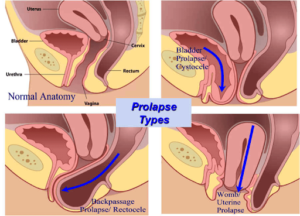
First off, what is a prolapse? There are many different kinds of prolapse, but the most common types occur when your bladder, rectum, or uterus start descending or bulging into the vaginal canal. (see photo below)
This can cause feelings of vaginal pressure or heaviness, like you have a tampon stuck inside, like something is bulging or falling out vaginally, or like it’s difficult to fully empty your bladder or bowels.
** Many women have the feeling of a prolapse without having significant anatomical changes or much sagging at all. Dysfunction with the pelvic floor can be the culprit contributing to these feelings of heaviness or falling out. Talk to your pelvic floor therapist to be sure!
What Causes Prolapse?
POP can result from changes in the ligaments, muscles, and/or nerves that support the pelvic organs, most commonly related to pregnancy and childbirth. However, genetic factors, aging, and conditions that place excessive pressure on the pelvic floor — such as chronic coughing, constipation, and repetitive heavy lifting — can also contribute to prolapse.
What Can Help?
- Avoiding constipation and optimizing bowel health
- Pelvic floor muscle training with a pelvic floor physical therapist
- Learning pressure management and coordination with movement
- Graded exposure to movement and progressive resistance training
- Internal support, such as a pessary
- External support, such as support shorts or support undergarments
- Topical estrogen or hyaluronic acid for those who are perimenopausal, menopausal, postpartum, or lactating
- Weight loss will likely not decrease prolapse symptoms (current research is mixed)
If I Have a Prolapse, Do I Have to Avoid Movement?
Short answer: no!
Providers often recommend avoiding lifting, running, and deep squatting for those with prolapse. However, these restrictions may unnecessarily limit exercise and the many benefits that come with it.
Research suggests that repetitive heavy lifting at work may contribute to the development or worsening of POP. However, progressively lifting weights during exercise has not been shown to cause or worsen prolapse.
“Heavy” looks different for every individual, and each person manages pressure differently. Temporary movement modifications may be helpful while you learn to manage symptoms, improve coordination, and build tolerance to the activities you want to return to.
Talk to your pelvic floor PT for individualized training recommendations and modifications based on your specific situation.
Will My Prolapse Keep Getting Worse?
Not necessarily.
Some people with POP do experience worsening symptoms or progression in the stage of prolapse, but many do not. Prolapse is not considered a “definitely progressive” condition.
Mild, asymptomatic POP is extremely common and is often considered a normal finding. It does not necessarily predict worsening prolapse later in life. For those with symptomatic prolapse, factors such as hormonal changes, vaginal tissue health, and nervous system sensitivity may influence future symptoms and outcomes.
Do I Need Surgery?
This is a personal decision based on many factors.
Many people with moderate to severe prolapse are able to manage their symptoms conservatively. If surgery is being considered, it can be helpful to consult with a pelvic floor PT and potentially trial a pessary first. This may help identify urinary incontinence that was previously masked by the prolapse and could become more noticeable after surgical repair.
Having prolapse or prolapse symptoms does not mean the end of movement or the activities you love. With proper treatment and management, symptoms can improve significantly.
Schedule a visit with us today to get assessed. We’re excited to help you get back to doing the things you love!
Information adapted from the POP info sheet by Dr. Terri Robertson Elder, PT, DPT, WCS